What is the elongation at break of a structural sealant? Structural Sealant
Hey there! I’m a supplier of structural sealants, and I often get asked about all sorts of technical stuff, one of the most common questions being about the elongation at break of our structural sealants. So, in this blog, I’m gonna break it down for you in plain English.
First things first, let’s talk about what structural sealants are used for. These sealants play a crucial role in construction. They’re used to bond and seal building components, like glass panels in curtain walls. They have to hold up under all kinds of conditions, whether it’s the heat of summer or the cold of winter, and they need to keep those components in place and watertight.
Now, let’s get into the meat of it – the elongation at break. Simply put, the elongation at break is the maximum amount a structural sealant can stretch before it breaks. It’s measured as a percentage. For example, if a sealant has an elongation at break of 200%, it means that before it snaps, it can stretch to twice its original length.
Why is this important? Well, think about the real – world situation. Buildings aren’t static. They expand and contract due to temperature changes, wind loads, and other environmental factors. When a building expands, the structural sealant between its components needs to stretch. If the sealant can’t stretch enough, it’ll break. And when it breaks, it means leaks can occur, and the structural integrity of the building might be compromised.
Let’s say you’re in a place with extreme temperature variations. During the summer, the building materials expand in the heat, and the sealant has to stretch to accommodate that expansion. If it doesn’t have a high enough elongation at break, it will crack, and water can start seeping in. This can lead to all sorts of problems, like water damage to the interior of the building, and in the long – term, it can even cause corrosion of the metal components.
On the flip side, during the winter, when the building contracts, the sealant needs to shrink back without losing its bond. A good structural sealant with an appropriate elongation at break will be able to do this without issue.
Now, different projects require different levels of elongation at break. For some small – scale, low – stress applications, a sealant with a relatively low elongation at break, say around 100% – 150%, might be sufficient. But for large, high – rise buildings or those in areas with extreme environmental conditions, you’ll need a sealant with a much higher value, like 200% or even more.
At our company, we offer a range of structural sealants with different elongation at break values to meet the diverse needs of our customers. We’ve spent years researching and developing these products to ensure that they offer the best performance in different situations.
Our team of experts tests each batch of sealants to make sure they meet the specified elongation at break requirements. We use a special testing machine that slowly stretches the sealant sample until it breaks. During the process, we carefully measure how much it stretches and calculate the percentage. Only after passing these rigorous tests do our sealants make it to the market.
We also understand that there are other factors to consider when choosing a structural sealant. Things like adhesion, durability, and chemical resistance are all important. That’s why we’ve designed our products to be well – rounded. Our sealants not only have excellent elongation at break but also strong adhesion to a variety of building materials, like glass, metal, and concrete. They can withstand exposure to UV rays, water, and chemicals without degrading quickly.
Another thing I want to touch on is the installation process. Even if you have a great sealant with a high elongation at break, if it’s not installed correctly, it won’t perform as expected. That’s why we offer comprehensive training and support to our customers. We can teach you the best practices for application, including surface preparation, joint design, and curing conditions. By following our guidelines, you can make sure that the sealant lives up to its potential and provides long – lasting performance.
So, to sum it up, the elongation at break of a structural sealant is a critical property that determines its ability to withstand the movement of building components. It can have a huge impact on the safety and durability of your building project. Whether you’re a contractor, an architect, or a building owner, choosing the right structural sealant with the appropriate elongation at break is essential.
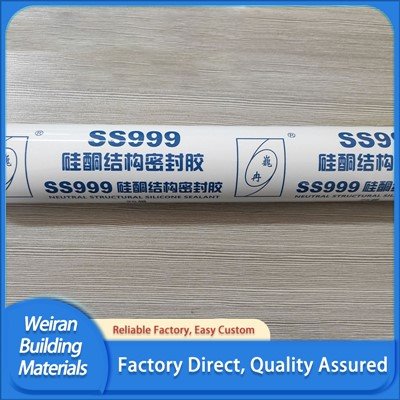
If you’re interested in learning more about our range of structural sealants or need some advice on which product is best for your project, we’d love to hear from you. Our team of experts is always ready to answer your questions and help you make the right choice. Contact us for a free consultation, and let’s work together to ensure the success of your construction project.
Structural Sealant References
- ASTM International. Standard test methods for properties of structural sealants.
- Building Sealant Manufacturers Association. Technical guidelines on sealant performance.
- Journal of Construction and Building Materials. Research on the relationship between sealant properties and building performance.
Shandong Weiran Building Materials Co., Ltd.
Shandong Weiran Building Materials Co., Ltd. is one of the most experienced structural sealant manufacturers and suppliers in China, also supports customized service with low price. Welcome to buy bulk high quality structural sealant in stock here from our factory. Contact us for quotation.
Address: No.1, Street-front Shop, Jia 19, No.137 East Xingyuan Road, Zhangdian District, Zibo City, Shandong Province, China
E-mail: qinjuan@sdwrjc.com
WebSite: https://www.sdwrjc.com/
